If you’ve been shopping for windows lately, you might have noticed that some windows come with a bright blue sticker verifying they’re ENERGY STAR certified. But what exactly does that mean?
For a window to be ENERGY STAR certified, it has to pass strict guidelines and testing protocols that deem it energy efficient. If the window doesn’t meet or surpass these guidelines, then it can’t be considered an ENERGY STAR product. This is an important certification for homeowners, as ENERGY STAR windows can significantly reduce energy costs.
Read on to learn more about what exactly an ENERGY STAR window is, what the requirements are, and how they can be beneficial to your home.
What Are ENERGY STAR Windows?
ENERGY STAR windows are any windows that meet the U.S. Environmental Protection Agency’s (EPA) energy efficiency guidelines under the Energy Star Program. These guidelines are meant to promote energy-efficient products that help save money and reduce greenhouse gas emissions.
Although many products can be considered ENERGY STAR (including refrigerators, laundry machines, and dishwashers), when it comes to windows, the goal is to certify windows that lower heat transfer and air leakage, keeping homes warmer in the winter and cooler in the summer.
How Do Windows Become ENERGY STAR Certified?
It’s not easy for a window to be considered ENERGY STAR certified! In order to do so, it must meet these three requirements:
- Manufactured by an ENERGY STAR partner.
- Tested, certified, and verified by the National Fenestration Rating Council (NFRC).
- Have NFRC ratings that meet the energy efficiency guidelines determined by the Environmental Protection Agency (EPA).
There are five different categories the NFRC tests windows for in order to determine their ratings: U-factor, solar heat gain coefficient (SHGC), air leakage, visible transmittance, and condensation resistance.
Confused a bit by what all of this means? That’s okay! Let’s learn exactly what these specific NFRC ratings are and what they measure.
How to Read an Energy-Star Window Rating
Every ENERGY STAR-certified window is required to leave the factory with a removable label that shows a product description, certification information, and, most importantly, its NFRC ratings. You can expect the NFRC ratings to look something like this:
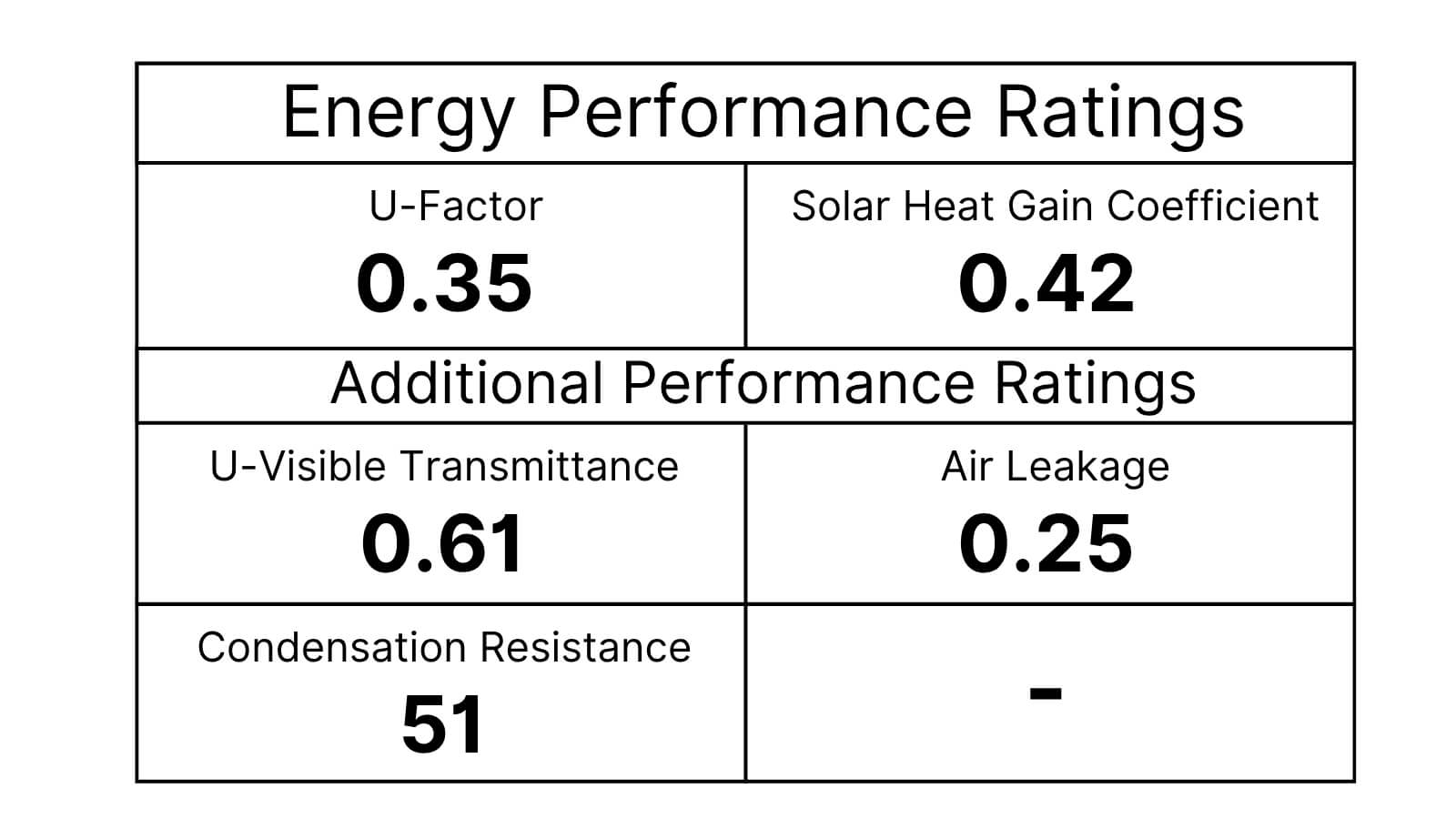
It may seem like a bunch of numbers, but they all mean something important about a window’s energy efficiency! Here’s what the ratings on those labels indicate:
U-Factor
The U-factor determines how much heat is able to escape through the window. The values will typically range from .25 to 1.25, with a lower score indicating that less heat is escaping.
Solar Heat Gain Coefficient (SHGC)
SHGC measures how much heat passes through your window, and is typically measured on a scale from 0 to 1. Homes in the Northern region, like Wisconsin, will want a higher SHGC score (likely somewhere around .35 to .60) to allow more heat in during the winter, while Southern region homes will want a lower SHGC score to help keep cool.
Visible Transmittance
Visible transmittance lets you know how much visible light passes through a window and can determine how much natural light you get in your home. Scores tend to fall somewhere between .20 and .80, with higher numbers indicating better light.
Air Leakage
Air leakage is exactly like its name—it measures how much air leaks through a window, with a good score being equal to or less than .30.
Condensation Resistance
This is an optional rating that only some NFRC windows will still include, as it measures how well a window prevents the build-up of condensation. The score is reported on a scale of 1 to 100, with a higher score meaning condensation is better kept at bay.
How Does Climate Affect ENERGY STAR Ratings?
The requirements for the ratings shown above differ by region within the United States. There are four regions designated by the NFRC (Northern, North Central, South Central, and Southern) that each have unique, separate rating requirements due to their varying climates, temperature fluctuations, and amounts of rain.
The Northern region, where Wisconsin is located, for example, requires ENERGY STAR windows with a U-factor score that is less than or equal to .27, while a state located in the Southern region requires a U-factor score of less than or equal to .40. Before buying an ENERGY STAR-certified window, make sure its NFRC ratings match those for your region.
Common ENERGY STAR Features
Although an ENERGY STAR window does not require the use of any specific technologies, there tend to be certain features that are more commonly found in ENERGY STAR-certified products, such as:
- High-Quality Frames: ENERGY STAR windows tend to have durable yet low-maintenance frames (such as fiberglass, vinyl, aluminum, or wood) that reduce the transfer of heat, therefore improving their insulating qualities.
- Low-E Glass: In order to reflect infrared and ultraviolet, most ENERGY STAR windows have low- emissivity (also known as Low-E) glass that is coated with a thin, microscopic layer of metal and silver. It helps keep buildings warm in the winter and cool in the summer.
- Multiple Panes: ENERGY STAR windows frequently have anywhere from two to three or more panes of glass. Not only does this method help with energy efficiency, but it can also help with sound insulation and impact resistance.
- Gas Fills: In between the multiple panes of glass frequently found on ENERGY STAR windows can be gas fills. These non-toxic gases (such as argon or krypton) are odorless, colorless, and have insulating properties.
- Warm Edge Spacers: In order to better insulate the window pane, most ENERGY STAR windows have a spacer that prevents temperatures from fluctuating too greatly around the edges of the window (where air is most likely to enter or escape).
What Are the Benefits of ENERGY STAR Windows?

Now that you understand exactly what it means for a window to be labeled as ENERGY STAR, it’s time to unpack all the benefits! All the testing and confusing labels are worth it because, in the end, ENERGY STAR windows offer things such as:
- Cost Saving: Did you know that ENERGY STAR windows can save you a national average of 13% on household energy bills? That comes out to about $71 to $501 a year!
- Tax Claim Benefits: Thanks to the Energy Efficient Home Improvement Credit, you can qualify for a tax credit for 30% of the cost of new ENERGY STAR windows (up to $600).
- Environmentally Friendly: By reducing the amount of energy you’re consuming with ENERGY STAR windows, you’re also reducing your carbon footprint.
- Increased Property Value: Upgrading outdated windows to eye-catching and energy-efficient ENERGY STAR models can increase property value and attract more buyers.
- Less Damage to Belongings: Prolonged sun exposure can cause your floors, furniture, and other furnishings to become bleached or discolored. However, the low-emissivity coating in ENERGY STAR windows means fewer UV rays will pass through and cause damage.
- Added Comfort: A home with ENERGY STAR windows will experience better temperature regulation, increased natural sunlight, and fewer drafts, thereby boosting overall comfort levels.
Contact Us Today
Interested in replacing your outdated, single-pane windows with ENERGY STAR-certified windows? Then contact us today! Thanks to our wide variety of ENERGY STAR-certified window styles and customization options, it’s never been easier to upgrade your home.